Showing posts with label 17th century. Show all posts

Tuesday, September 29, 2026

How little-known European conflicts sucked in Britain’s American colonies


Note: This post covers a number of conflicts in various parts of the world. But all of them are arguably part of a larger pattern of European wars during this period. Thus, many of my other mentions of these conflicts are directed to this post, which tries to discuss these various conflicts (and sub-conflicts) in this broader colonial context.

Dutch colony of New Netherland (America), and the First and Second Anglo-Dutch Wars

It was only seven years after the 1607 founding of the Jamestown Settlement … that Holland created its own colony in North America. It was called “New Netherland,” and it was founded in 1614. Only six years later was the Pilgrim colony created at Plymouth Rock in 1620. French Canada had begun to fight the Beaver Wars back in 1609. These Beaver Wars would then be fought for the next 90 years or so. In 1635, the Acadian Civil War also began in French Canada. But, elsewhere in North America, the Netherlands would soon be fighting a war against the native peoples, known as “Kieft’s War.” It was fought from 1643 to 1645, in what are today the American states of New York and New Jersey. But Holland would soon be at war with a much greater threat: the mighty “English” Empire (not to be confused with its eventual successor, the “British” Empire). Thus, in 1652, the First Anglo-Dutch War began, over disputes about trade. This particular war was fought almost entirely at sea, in various bodies of water – from the English Channel to the Persian Gulf. In 1654, the war ended with the Treaty of Westminster, where the Dutch made some minor concessions to the English. The aforementioned Acadian Civil War also ended in 1654, although the aforementioned Beaver Wars continued. But, in 1665, the Second Anglo-Dutch War began. Like its predecessor, this war was fought mainly at sea. However, there was also some land fighting in West Africa, the East Indies, the Guianas, and the Caribbean. In North America, the war also involved the city of New Amsterdam surrendering to the English. Thus, in 1664, New Amsterdam was then renamed “New York City,” the name by which it is still known today. In 1667, the Second Anglo-Dutch War ended with the Treaty of Breda. Thus, the Dutch colony of New Netherland temporarily ended in 1667. However, England also ceded English Guiana, Fort Amsterdam in Ghana, and Run to the Netherlands. The stage was thus set for a rematch.


The Battle of Scheveningen – part of the First Anglo-Dutch War, 1653


The Four Days’ Battle – part of the Second Anglo-Dutch War, 1666

Saturday, May 23, 2026

The Thirty Years’ War was intertwined with many other conflicts


The Thirty Years’ War eventually claimed at least four million lives …

It was one of the most destructive wars in European history. The Thirty Years’ War eventually claimed at least four million lives. It was part of the European wars of religion, which arose in the wake of the Protestant Reformation. Several wars which began long before it, and several other wars which ended long after its termination, would eventually become connected with the massive “Thirty Years’ War.” This means that it was part of a series of conflicts that rocked the European world – and some of them spilled over into other parts of the world as well. Thus, this might be a good time to look at a few of these forgotten conflicts, and what they can tell us about early modern Europe. Some of these conflicts began back during the Renaissance and the Reformation, while others continued into the Age of Enlightenment. But all of them would leave casualties behind them, leaving a trail of destruction from one end of the Continent to the other.


Gustavus Adolphus of Sweden at the Battle of Breitenfeld, 1631 – part of the Thirty Years’ War


The Sack of Magdeburg, 1631 – part of the Thirty Years’ War

Monday, April 27, 2026

Forgotten world empires: The rise and fall of the Dutch Empire


During the Enlightenment, the Netherlands were one of the world’s great imperial powers. They were then one of the freest countries in the world. They had a large measure of freedom of religion, as well as a high measure of free markets. These things contributed to make them one of the greatest powers of their time. This might seem ironic, because Holland was then (and still is now) a small country. But its robust economy gave it power far beyond its numbers. The Dutch colonial empire rose to be one of the greatest empires in the world. But, eventually, most of that empire was lost, and the Dutch Empire then went the way of many other great empires of the past. Obviously, there is a darker side to this colonial empire, as there was with every other such empire in history. But there may still be a few things to learn from their astonishing success story. And we might also be able to learn a few things from this empire’s decline and fall.


The Amsterdam Stock Exchange, circa 1670

Monday, January 26, 2026

The Great Turkish War: How Europe fought back against the Ottomans


In the seventeenth century, the Ottoman Empire was making many enemies in Europe

The seventeenth century was rocked by several wars in Europe. But this century also saw a few major wars in the Middle East as well. For example, there were the forgotten Mughal-Safavid Wars. These wars were fought intermittently for many decades – before, during, and after the seventeenth century. There was also another major power in the Middle East, which was the Ottoman Empire. Unlike these other powers, it had ambitions in Continental Europe itself. The Ottoman Empire had been expanding further and further into the Balkans, and even into Central and Eastern Europe. But the Ottoman Turks were then making many enemies in Europe. Thus, the Ottomans were getting a little over-extended there. The Turks would soon be facing coalitions of several European powers – including the Russians, whom they had faced in two prior wars. The Ottoman Turks had also fought a few wars against Poland in the past, and would soon be facing the Poles again in this struggle. And some prior conflicts with the Habsburg monarchy would also be re-ignited in the coming struggle. Sadly for the Turks, there would be other enemies for them, as the Europeans decided to fight back against the Ottoman incursions. United by a common interest, their alliance would soon prove formidable to the Turks, in a conflict sometimes called the “Last Crusade.” Small wonder, then, that the Ottoman Turks would remember it simply as the “Disaster Years.” But the rest of the world would usually remember it … as the “Great Turkish War.” Like the prior Mughal-Safavid Wars, the “Great Turkish War” would prove one of the greatest conflicts of the seventeenth century. In this conflict, much of Christian Europe would band together, in a “holy resistance” to the Muslim invaders.


Battle of Vienna, 1683 – the opening battle of the Great Turkish War


Battle of Párkány, 1683 – part of the Polish-Ottoman War

Friday, September 19, 2025

Piracy played a role, early in the “Second” Hundred Years’ War


“When I was a boy, there was but one permanent ambition among my comrades in our village [Hannibal, Missouri] on the west bank of the Mississippi River. That was, to be a steamboatman. We had transient ambitions of other sorts, but they were only transient. When a circus came and went, it left us all burning to become clowns … now and then we had a hope that if we lived and were good, God would permit us to be pirates.”


Those pirate movies that you watched as a kid … probably took place during this period

In 2003, Disney released the first installment in their “Pirates of the Caribbean” film franchise. The film must have seemed a little risky, because there had not been a popular pirate movie for some years by that point. But, to everyone’s surprise, the film franchise did quite well at the box office, and in the later home movie sales as well. Other pirate movies (such as “Treasure Island”) have likewise captured the public imagination. As “Peter Pan” reminds us, pirates are a popular subject, especially with children. In “Life on the Mississippi,” Mark Twain once said that “we had a hope that if we lived and were good, God would permit us to be pirates” (as cited above). Obviously, the reality of piracy is a little less romantic, since pirates tended to be as violent and bloodthirsty as they’re usually portrayed to be. But, in some ways, the reality may be just as interesting as its depiction in these great movies. Today, I’d like to examine the role of piracy, during the aptly-named “Golden Age of Piracy.” This was the period when piracy became a significant factor in both the North Atlantic and the Indian Ocean. I should clarify that the term “Golden Age” is not meant to “approve” of the brazen theft that this piracy inherently involves. But, from the pirates’ point of view, it was indeed a “Golden Age,” where the world’s maritime trade was relatively vulnerable to their attacks. I will focus primarily on how it affected some of the major international wars of the period, particularly on the high seas. Indeed, it seems hard to discuss either the piracy or the wars in total isolation from each other. Specifically, I will start by talking about the three main Anglo-Dutch Wars, which were mostly at sea. Then I will focus on the naval parts of three other great European conflicts. These are (in order): the Nine Years’ War, the War of the Spanish Succession, and the War of the Austrian Succession. These three conflicts, along with four others that soon followed them, would eventually be grouped together into the broader term of “Second” Hundred Years’ War. Piracy and privateering played a major role, in the early parts of this much-larger conflict.


Spanish Men-of-War Engaging Barbary Corsairs, 1615

Tuesday, June 10, 2025

A review of “The Salem Witch Trials” (History Channel)


“Thou shalt not suffer a witch to live.”


They’re among the most infamous trials in American history. In both 1692 and 1693, more than 200 people were prosecuted in the Salem witch trials. Thirty of them were convicted, nineteen of whom were executed by hanging. One other man was tortured to death when he refused to enter a plea. At least five others died by disease in the jails. But how could this horrible event have happened? What does it tell us about human nature? And what parallels, if any, might these witch-hunts have with today? These are the questions (admittedly somewhat loaded questions) that this post shall attempt to answer.


Monday, March 24, 2025

The English Empire: The predecessor of the British Empire


“In the reign of king Henry the seventh, his ministers (not to say the king himself) were more industrious in hunting out prosecutions upon old and forgotten penal laws, in order to extort money from the subject, than in framing any new beneficial regulations. For the distinguishing character of this reign was that of amassing treasure into the king's coffers, by every means that could be devised: and almost every alteration in the laws, however salutary or otherwise in their future consequences, had this and this only for their great and immediate object.”


In 1485, the last Plantagenet king of England fell in battle. His name was Richard the Third, and he was killed on the battleground of Bosworth Field. The winner of the battle was a young man named Henry, who then became “Henry the Seventh.” He was the first of the Tudor rulers of England. Henry had been on the Lancastrian side of the “Wars of the Roses.” But, when he married a Yorkist lady in 1486, the two factions from the civil war were finally united, since he was marrying someone from that faction. Her name was Elizabeth of York, and she would eventually give birth to a son in 1491. The boy was the future “Henry the Eighth,” who would eventually form the new “Church of England.” (More about that here.) But, at that time, the boy’s birth signaled a formal end to the “Wars of the Roses.” The following year was 1492, the year that Christopher Columbus was arriving in the Americas. Spain and Portugal would soon be creating massive overseas empires, in which they spread their longtime Catholic faith to distant shores. Henry the Seventh was still the king of England in 1496, when he commissioned John Cabot to sail to Asia. Cabot sailed in 1497, but instead landed on the coast of Newfoundland – in what is today Canada. They did not yet attempt to found a colony there. Cabot later made another voyage to the Americas, but did not return. To this day, no one knows what happened to Cabot’s ships.


A replica of John Cabot’s ship the Matthew

Sunday, November 19, 2023

A review of the BBC’s “The Stuarts & The Stuarts in Exile”


“… all and every person and persons, who shall or may take or inherit the said Crown, by virtue of the limitation of this present act, and is, are or shall be reconciled to, or shall hold communion with, the See or Church of Rome, or shall profess the popish religion, or shall marry a papist, shall be subject to such incapacities [to rule], as in such case or cases are by the said recited act provided, enacted, and established …”


During the English Civil War, one king from this dynasty was executed …

During the English Civil War, one of the Stuart kings of England was executed. Specifically, Charles the First was beheaded by Oliver Cromwell and his allies in 1649. This was probably the most dramatic moment of the entire Stuart dynasty, but there are many other such moments. The Stuarts have a fascinating history, and left an indelible mark upon the history of the British Isles. Thus, the BBC decided to examine this story in the 2010s, by engaging Clare Jackson to make this documentary. It must have been reasonably popular, because they later added two bonus episodes to the original three in that same decade. More about those later. For now, let me examine the original three episodes, which were simply marketed as “The Stuarts.” I will cover “The Stuarts in Exile” somewhat later in this post.


Charles the First

Monday, June 19, 2023

The unknown story behind the King James Version of the Bible


“If God spare my life, ere many years I will cause a boy that driveth the plough, shall know more of the Scripture than thou dost!”

– William Tyndale (author of an early translation of the Bible into English), in a heated exchange with a priest

What led up to the King James Version of the Bible (first published in 1611)?

Even today, the King James Version of the Bible is the most commonly-used Biblical translation in the United States. Its influence is declining in some other English-speaking countries, but its status still remains strong today in many others. Even among atheists like Richard Dawkins, it is acknowledged as “a great work of literature.” Dawkins also added that “A native speaker of English who has never read a word of the King James Bible is verging on the barbarian.” Certainly the KJV (as it is often abbreviated) has had a great influence upon the history of the English language. One would have to turn to Shakespeare to find comparable influence upon the history of our own language. I would like to pay a brief tribute to the unsung heroes who helped to bring us this translation into English, as well as those who brought us other translations into other languages. But my focus here will be on the history involved, and what led to the writing of the King James Bible.


St. Jerome, mentioned below

Sunday, December 25, 2022

A review of “Isaac Newton’s New Physics” (audiobook)


“If I have seen further it is by standing on the shoulders of giants.”

– Isaac Newton, in a letter to Robert Hooke on 5 February 1675

Sir Isaac Newton revolutionized how human beings see the world … and the universe. He may have been the most influential scientist of all time. It is said that Albert Einstein kept a picture of Newton on his “study wall,” alongside his other pictures of Michael Faraday and James Clerk Maxwell. But in Newton’s time, the word “scientist” did not exist yet, nor did the phrase “natural science.” Instead, the subject was described as “natural philosophy,” making Newton into a “natural philosopher.” In modern philosophical terms, Newton would be in the empirical tradition, although he showed the influence of some Continental Rationalists like RenĂ© Descartes as well.


Monday, September 5, 2022

A review of “Versailles” (French documentary)


“L’Ă©tat, c’est moi.” (“I am the State.”)

– A line attributed to King Louis XIV of France – a line that he may or may not have actually said, but which nonetheless seems to accurately express his views on government (and himself)


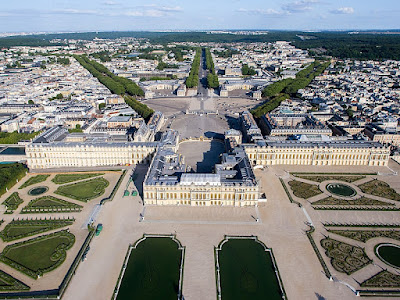
Aerial view of the Palace of Versailles

A film about three kings of France, one of whom was executed …

In 1643, a new king was crowned in France. Officially, he would be known as Louis the Fourteenth, but he is also known by the nickname of “Le Roi Soleil” (or “The Sun King”). Some consider him the longest-reigning absolute monarch in history. The term “absolute” is appropriate here, because he ruled with an iron fist. But this film doesn’t just cover him – they also cover two other kings as well, both of whom were his descendants. One was Louis the Fifteenth, who is known by the nickname “Louis le Bien-AimĂ©” (“Louis the Beloved”). This nickname is somewhat ironic, because he became somewhat unpopular later on. And the other king was Louis the Sixteenth, who is best known for dying by the guillotine, when he was executed during the French Revolution. They were three kings in a row, with no other kings in between – either by the name “Louis,” or by any other name. Together, they reigned for a period of nearly a century and a half.


Execution of King Louis the Sixteenth by the guillotine, 1793

Tuesday, February 15, 2022

A review of “Astronomy: The Heavenly Challenge” (audiobook)


The battle over the Sun-centered universe was as much political as it was scientific. During the sixteenth and seventeenth centuries, a theory that had been defended since antiquity was suddenly challenged by the new theory that the Earth revolved around the Sun. In antiquity, the Earth had not yet been recognized as a “planet.” Thus, there was no apparent contradiction in saying that the Sun and the “planets” revolved around the Earth. At this time, it seemed to be the most natural theory in the world. Most importantly, it was defended by the Catholic Church – which held political as well as doctrinal power, and was at the peak of its military and political might.


Thursday, November 21, 2019

A review of Ric Burns’ “The Pilgrims” (PBS)


“Having undertaken for the Glory of God, and Advancement of the Christian Faith, and the Honour of our King and Country, a Voyage to plant the first Colony in the northern Parts of Virginia; [we] Do by these Presents, solemnly and mutually, in the Presence of God and one another, covenant and combine ourselves together into a civil Body Politick, for our better Ordering and Preservation, and Furtherance of the Ends aforesaid … ”

– The Mayflower Compact, 11 November 1620 by the old calendar (or 21 November 1620 by the new calendar)

I grew up with the story of the Pilgrim Fathers, who settled at Plymouth Rock in Massachusetts (and not in Virginia, as they had originally intended). It is one of the great stories in American history, but it was not the beginning of the English colonies on this continent. Before the Mayflower landed at Plymouth Rock in 1620, there was a settlement in Jamestown, Virginia in 1607. But this Jamestown settlement wasn't anywhere near as successful as the later Pilgrim settlement. Both were racked by starvation and disease that claimed many lives, but the Pilgrim settlement survived, when the Jamestown settlement did not. Some brief comments about the Jamestown settlement may thus be warranted here, to give you an appreciation of what the Pilgrims did (although their success was marred somewhat by their relations with the Indians, in the ways that I will note soon).


Some brief comments about the Jamestown settlement (and the PBS documentary about it)

Regarding the Jamestown settlement, I actually purchased another documentary called “Secrets of the Dead: Jamestown's Dark Winter” (also by PBS). This voyage did actually land in Virginia, as they had originally intended (unlike the Pilgrim voyage, which landed in Massachusetts). But sadly for me, this Jamestown documentary was more focused on the archaeology involved than on the history. Thus, it is not to be construed as an actual “history” of the Jamestown settlement. The focus here is on the archaeological examination of the human remains found there. For example, they were able to show in this documentary that the grim stories about resorting to cannibalism at Jamestown were actually true. Although this was gross, it was certainly dramatic enough; but it did not satisfy my craving for the human story of what happened there. There was some passing mention of John Smith and Pocahontas, for example, but most of the story centered on the body of a teenage girl whose real name is unknown (although they call her “Jane” to identify her as a Jane Doe.) The definitive documentary about what happened at Jamestown, it would seem, thus has yet to be made at the time that I write this. By contrast, this documentary about “The Pilgrims” was much better; although it was not without some revisionist elements that I will note later on in this post. For now, I will just say that I found it to be entertaining despite its revisionism, and would recommend it to others anyway.


Monday, July 8, 2019

A review of “Japan: Memoirs of a Secret Empire” (PBS Empires)


Japan's initial contact with the West in 1543

In the year 1543, a Portuguese trading ship arrived in the Japanese island of Tanegashima. Its passengers were the first Europeans to set foot in Japan. From a European perspective, they “discovered” Japan; but from an Asian perspective, they were not the first people to “discover” these islands; since these islands had been inhabited for centuries by that time. An ancient civilization resided here, with its own language, culture, and religions. At least one of its major religions (namely, Buddhism) had been imported from outside, but its Shinto religion was native to Japan itself. To those who lived in Japan, their empire was no “secret.” But to the people back in Europe, this island was indeed a “secret empire.” The European empires were equally “secret” to the Japanese, of course; and to the Japanese, these Christian Europeans were something of a novelty; and so were the strange goods that they carried.


Japanese painting depicting a group of Portuguese foreigners

Early trade with Europeans, including in weapons

The Portuguese carried valuable cargo that they wanted to trade for the Japanese goods. Both sides were eager to engage in this trade, as it turns out, and so Japan's first contact with Europeans established a long relationship with the West. This relationship would not always be as friendly as it was here, but the strange European imports have long fascinated the Japanese. The most important of these imports at this time was the musket. The Japanese realized very early on that these European weapons were very powerful. The Europeans were willing to sell them these weapons for a price, and certain tribes in Japan took them up on this offer. The ones that “got in” on this trade the earliest were able to dominate the other tribes via these weapons, and so these weapons had a massive effect on Japanese internal politics. This documentary starts at the moment of initial contact in the sixteenth century, and continues on through the end of Japanese isolationism in the nineteenth century. Internal Japanese politics are also covered, of course, but there is also a strong emphasis on Japan's complicated relationship with the West.


Various antique Tanegashima muskets

Saturday, April 25, 2015

Cromwell: The movie that brings the English Civil War to life


The English Civil War was a war over ideas, much like the American Revolution ...

The British historian Simon Schama once said that the American Declaration of Independence was "like a chapter from a British history book." He compared the American Revolution to the English Civil War of a century before, even going so far as to say that the American Revolution was really "round two" of the British civil wars. There is truth in this statement, and the events of the English Civil War are eerily familiar to students of the American Revolution. They both were political wars, they both were wars over ideas, and they both began as wars over taxes; which soon transformed into conflicts about much broader issues.


Battle of Naseby, 1645 (during English Civil War)