Showing posts with label 18th century. Show all posts

Tuesday, September 29, 2026

How little-known European conflicts sucked in Britain’s American colonies


Note: This post covers a number of conflicts in various parts of the world. But all of them are arguably part of a larger pattern of European wars during this period. Thus, many of my other mentions of these conflicts are directed to this post, which tries to discuss these various conflicts (and sub-conflicts) in this broader colonial context.

Dutch colony of New Netherland (America), and the First and Second Anglo-Dutch Wars

It was only seven years after the 1607 founding of the Jamestown Settlement … that Holland created its own colony in North America. It was called “New Netherland,” and it was founded in 1614. Only six years later was the Pilgrim colony created at Plymouth Rock in 1620. French Canada had begun to fight the Beaver Wars back in 1609. These Beaver Wars would then be fought for the next 90 years or so. In 1635, the Acadian Civil War also began in French Canada. But, elsewhere in North America, the Netherlands would soon be fighting a war against the native peoples, known as “Kieft’s War.” It was fought from 1643 to 1645, in what are today the American states of New York and New Jersey. But Holland would soon be at war with a much greater threat: the mighty “English” Empire (not to be confused with its eventual successor, the “British” Empire). Thus, in 1652, the First Anglo-Dutch War began, over disputes about trade. This particular war was fought almost entirely at sea, in various bodies of water – from the English Channel to the Persian Gulf. In 1654, the war ended with the Treaty of Westminster, where the Dutch made some minor concessions to the English. The aforementioned Acadian Civil War also ended in 1654, although the aforementioned Beaver Wars continued. But, in 1665, the Second Anglo-Dutch War began. Like its predecessor, this war was fought mainly at sea. However, there was also some land fighting in West Africa, the East Indies, the Guianas, and the Caribbean. In North America, the war also involved the city of New Amsterdam surrendering to the English. Thus, in 1664, New Amsterdam was then renamed “New York City,” the name by which it is still known today. In 1667, the Second Anglo-Dutch War ended with the Treaty of Breda. Thus, the Dutch colony of New Netherland temporarily ended in 1667. However, England also ceded English Guiana, Fort Amsterdam in Ghana, and Run to the Netherlands. The stage was thus set for a rematch.


The Battle of Scheveningen – part of the First Anglo-Dutch War, 1653


The Four Days’ Battle – part of the Second Anglo-Dutch War, 1666

Saturday, July 4, 2026

A review of Ken Burns’ “The American Revolution” (PBS)


“But when a long train of abuses and usurpations, pursuing invariably the same object, evinces a design to reduce them under absolute despotism, it is their right, it is their duty, to throw off such government, and to provide new guards for their future security. Such has been the patient sufferance of these colonies; and such is now the necessity which constrains them to alter their former systems of government.”


My prior concerns about this series, and how my hopes for this series were restored

When I first saw Ken Burns’ prior series “The Civil War,” I was mesmerized by it. I still consider it to be among the greatest series ever made, of any kind. And, in many ways, I was looking forward to seeing Ken Burns’ coverage of the American Revolution as well. But I confess that I also had some concerns about how he would cover this massive (and important) topic. These concerns were partially stoked by his biographical film about Thomas Jefferson, which could almost be described as a hatchet job. The film had so much coverage of his slaveholding, and his relationship with Sally Hemings (both legitimate topics), that it drowned out his considerable role in drafting the Declaration of Independence. But, thankfully, my confidence in Ken Burns’ coverage was restored somewhat, when I saw his biographical film about Benjamin Franklin. This proved far more sympathetic, and gave me hope that he would cover the American Revolution in a (somewhat) more sympathetic light. Ken Burns definitely covers the slavery issues, and he also covers the comparable issues surrounding Native American involvement. Both of these receive a lot of time in this series. But he also shows that the British were willing to sacrifice Black and Native American interests to their own war aims, even if they still tended to offer a better deal to these two ethnic groups than the Patriot side did. And he shows that there were many Blacks and Native Americans who fought for the Patriot side, even if there were still far more of them who fought for the British and Loyalist side.


Sunday, February 22, 2026

How the Great Northern War facilitated the rise of Russia


The Renaissance and the Enlightenment both saw some major wars in Northern Europe

The Renaissance and the Enlightenment both saw some major wars in Northern Europe. They have gone down in history simply as the “Northern Wars.” I should acknowledge here that this is an international topic. Perhaps partially because of this, there is actually some controversy about what to include here in the simple term “Northern Wars.” There is even a significant controversy about the very names of these conflicts. Because of this, I will try to avoid controversial terminology like the “First” Northern War, or the “Second” Northern War. These are not internationally accepted, since there is no international standard for the nomenclature here. Thus, I will try to use neutral terms which are clearer, in an effort to avoid names that will be interpreted differently by different groups. Regardless, they would ultimately culminate in the “Great Northern War.” This was one of the greatest conflicts of the eighteenth century. In this case, the name is accepted much more widely. And it is also acknowledged that this was the largest (and last) in this great series of wars.


Peter the Great assaults Nöteborg, part of the Great Northern War (circa 1702)

Saturday, October 18, 2025

The War of the Austrian Succession was fought on four different continents


Note: The “War of the Austrian Succession” included several different conflicts within it. Thus, many of my blog’s mentions of these related conflicts are instead directed to this post, which helps to put many of these conflicts (and sub-conflicts) into context.

Anecdote about the “War of Jenkins’ Ear,” and how that conflict got its strange name

In 1731, a British ship called the “Rebecca” was stopped by a Spanish ship. As Wikipedia puts it, “Under the 1729 Treaty of Seville, the Spanish were allowed to check British vessels trading with the Americas for contraband.” (see source) Thus, the Spaniards searched the ship thoroughly, and found that it was indeed carrying smuggled sugar. The captain of the “Rebecca” was a man named Robert Jenkins. Captain Jenkins later alleged that, during this incident, the Spaniards had removed part of his ear. The British government was then looking for a pretext for a war against Spain. Thus, they brought Captain Jenkins into Parliament, as evidence that his ear had been cut off by Spanish officials. But Captain Jenkins was wearing a cap, which concealed how many ears he had. Moreover, Captain Jenkins was never forced to remove this cap. Thus, there was a suspicion that, underneath his cap, there were two perfectly normal ears – each of which was firmly attached to his head in the normal way. But the war seemed too desirable to the British to bother with such “trivialities” as verification of the story. Thus, the “War of Jenkins’ Ear” soon began in 1739. This may be among the strangest names ever given to any conflict in history. The majority of the conflict took place in New Granada and the Caribbean Sea. However, it would also involve some fighting in Havana, Cuba – and in Central America, at a city called Cartagena (not to be confused with the city back in Spain). North America would also see some related fighting in Spanish Florida and British Georgia, which was part of the “War of Jenkins’ Ear.” This would later become a part (arguably) of the “War of the Austrian Succession.”


Capture of Portobelo (Central America, 1739) – part of the “War of Jenkins’ Ear”


Battle of Havana (Cuba, 1748) – another part of the “War of Jenkins’ Ear”

Friday, August 15, 2025

Great naval conflicts: From the Seven Years’ War to the Napoleonic Wars


Many pirate movies take place in this general time period, and so do many history movies

I grew up on pirate movies like “Treasure Island,” a classic story that takes place in the early eighteenth century. Most modern pirate movies seem to take place in this much-romanticized era of sailing ships and pirates. In this century, we have seen Disney’s fantasy-oriented “Pirates of the Caribbean,” which combines this eighteenth-century historical backdrop with elements of curses and magic. But there have also been more “serious” works of historical fiction, about the naval conflicts of the late eighteenth (and early nineteenth) centuries. For example, there has been the “Horatio Hornblower” franchise (with a TV series starring Ioan Gruffudd), and the Russell Crowe movie “Master and Commander.” (Pity that only one movie was made in that particular franchise, because it was a promising one.) These movies may have some fictional characters in them, along with references to real people like Lord Horatio Nelson. But they may still be “serious” historical movies anyway, in my opinion, since they dramatize the fighting at sea during the Napoleonic Wars.


The wars covered here were all part of a broader struggle between Britain and France

I’m much interested in the naval fighting of the Napoleonic Wars, in part because of the influence of these movies on me personally. But, today, I would like to look at naval fighting in the eighteenth century more generally. The Napoleonic Wars are traditionally dated to the early nineteenth century, and I promise the reader that I will also be giving some serious coverage of that conflict in this post. But, in order to understand the Napoleonic Wars themselves, one has to look at some prior conflicts in the eighteenth century. Most importantly, one has to look at the much broader struggle between Britain and France, and how they duked it out in one maritime conflict after another. Our story begins in 1754, with a frontier conflict in the distant European colonies of North America. Americans today remember it as the “French and Indian War,” but it would soon lead to the broader “Seven Years’ War,” and to many another great naval conflict for the Europeans.


Monday, July 14, 2025

The “French Revolutionary Wars”: A great European cataclysm


“Do you hear in the fields
The howling of those fearsome soldiers?
They are coming into your midst
To slit the throats of your sons and consorts.

To arms, citizens!
Form up your battalions!
Let’s march, let’s march!
May impure blood soak our fields’ furrows!”

– English translation of “La Marseillaise” (1792), originally written in French during the French Revolution – now used as the national anthem of France

The French Revolution sucked much of Europe into a decade of bitter warfare

In 1789, a French mob stormed the Bastille on the 14th of July. This is the most famous date of the French Revolution, with its anniversary today celebrated in France as “Bastille Day.” This is actually the national holiday of France today, much as “Independence Day” is the national holiday of the United States. But there’s more to the story than this domestic revolution, although that is a critically important part of it. The French Revolution also sucked much of Europe into a decade of bitter warfare. The later years of the French Revolution were thus set against the backdrop of warfare. That is, there was an overlap between the later “French Revolution” and the early “French Revolutionary Wars.” This post will cover the often-forgotten conflicts that were associated with the French Revolution. I have saved my coverage of the Napoleonic Wars for another post, even though these two topics are intimately connected. Thus, I will instead be focusing here on the “French Revolutionary Wars,” which lasted for ten years in all. In so many ways, they were a great European cataclysm.


Storming of the Bastille, 1789

Saturday, May 17, 2025

The Seven Years’ War was a massive worldwide conflict


“The free exercise of the roman religion [in Canada] is granted, likewise safe guards to all religious persons, as well as to the Bishop, who shall be at liberty to come and express, freely and with decency, the functions of his office, whenever he shall think proper, until the possession of Canada shall have been decided between their Britannic and most Christian [French] Majesties.”


The Seven Years’ War was a true world war, fought on five different continents

When we think of the eighteenth century, we usually think of the great revolutions in America and France, which were in the latter half of that century. And these revolutions obviously were quite important. But these revolutions were an outgrowth of previous conflicts, including (arguably) the Seven Years’ War. The Seven Years’ War was a true world war, to a degree that the later Napoleonic Wars were not. Specifically, the Seven Years’ War would eventually be fought on five different continents. The conflict would have profound consequences for the fate of empires, and even for the map of the world. There has been at least one major documentary about the “French and Indian War,” a related war that helped to spark the larger “Seven Years’ War.” But no documentary overview of the Seven Years’ War has yet been attempted. Thus, it seems to remain mostly forgotten today. Therefore, I would like to attempt an overview of this conflict, and of the many sub-conflicts that were a part of it. That is, I will try to show how the Seven Years’ War rocked the eighteenth-century world, and how it was fought from one end of this globe to the other.


Naval battle of Quiberon Bay, 1759 – Off the coast of Brittany, France

Tuesday, June 18, 2024

The British Empire: From the Acts of Union to the Battle of Waterloo


The eighteenth century was a crucial period for the British Empire. It saw the birth of the “Kingdom of Great Britain” itself, in the 1707 “Acts of Union.” It saw much-admired advances in philosophy, from the English philosophers to the “Scottish Enlightenment.” And it saw many important political developments for the British Empire, at home and abroad. For example, it saw the continuation of an ongoing struggle between Britain and France. Britain would be affected by the loss of many of its overseas colonies in North America. Much closer to home, it was affected by the French Revolution, and the chaos left in its wake. Thus, in the early nineteenth century, it would eventually fight the Napoleonic Wars, one of the defining conflicts of its history. Therefore, an examination of this general period might be in order here. That is, I plan to go from the 1707 “Acts of Union” … to the Battle of Waterloo in 1815. This period has a massive legacy for the British Empire, and for many of its former overseas colonies.


Battle of Trafalgar – Spain, 1805

Monday, September 5, 2022

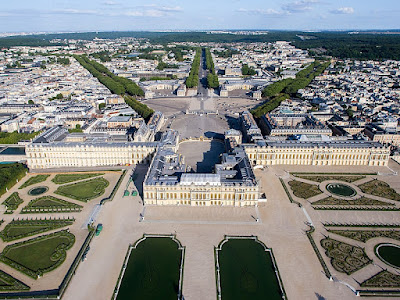
A review of “Versailles” (French documentary)


“L’état, c’est moi.” (“I am the State.”)

– A line attributed to King Louis XIV of France – a line that he may or may not have actually said, but which nonetheless seems to accurately express his views on government (and himself)


Aerial view of the Palace of Versailles

A film about three kings of France, one of whom was executed …

In 1643, a new king was crowned in France. Officially, he would be known as Louis the Fourteenth, but he is also known by the nickname of “Le Roi Soleil” (or “The Sun King”). Some consider him the longest-reigning absolute monarch in history. The term “absolute” is appropriate here, because he ruled with an iron fist. But this film doesn’t just cover him – they also cover two other kings as well, both of whom were his descendants. One was Louis the Fifteenth, who is known by the nickname “Louis le Bien-Aimé” (“Louis the Beloved”). This nickname is somewhat ironic, because he became somewhat unpopular later on. And the other king was Louis the Sixteenth, who is best known for dying by the guillotine, when he was executed during the French Revolution. They were three kings in a row, with no other kings in between – either by the name “Louis,” or by any other name. Together, they reigned for a period of nearly a century and a half.


Execution of King Louis the Sixteenth by the guillotine, 1793

Sunday, September 6, 2020

A review of “Lafayette: The Lost Hero” (PBS)


“If War should break out between France and Great Britain, during the continuance of the present War between the United States and England, his [French] Majesty and the said united States, shall make it a common cause, and aid each other mutually with their good Offices, their Counsels, and their forces, according to the exigence of Conjunctures as becomes good & faithful Allies.”

“In order to fix more precisely the sense and application of the preceding article, the Contracting Parties declare, that in case of rupture between France and England, the reciprocal Guarantee declared in the said article shall have its full force and effect the moment such War shall break out … ”

– Articles 1 and 12 of the “Treaty of Alliance Between The United States and France” (6 February 1778)

Fellow Americans tend to remember the American Revolution as a time of heroes. The names of Franklin, Washington, Adams, Hamilton, Jefferson, and Madison are known widely in this country. And for many Americans, the Marquis de Lafayette is right up there in the pantheon with these Founding Fathers, even though he was obviously not an American himself. As you may know, he was born a Frenchman, and was a citizen of France throughout his life. He never sought to obtain American citizenship, and was highly patriotic to France. Why, then, is he remembered with such fondness by so many Americans today?


Marquis de Lafayette

Monday, July 8, 2019

A review of “Japan: Memoirs of a Secret Empire” (PBS Empires)


Japan's initial contact with the West in 1543

In the year 1543, a Portuguese trading ship arrived in the Japanese island of Tanegashima. Its passengers were the first Europeans to set foot in Japan. From a European perspective, they “discovered” Japan; but from an Asian perspective, they were not the first people to “discover” these islands; since these islands had been inhabited for centuries by that time. An ancient civilization resided here, with its own language, culture, and religions. At least one of its major religions (namely, Buddhism) had been imported from outside, but its Shinto religion was native to Japan itself. To those who lived in Japan, their empire was no “secret.” But to the people back in Europe, this island was indeed a “secret empire.” The European empires were equally “secret” to the Japanese, of course; and to the Japanese, these Christian Europeans were something of a novelty; and so were the strange goods that they carried.


Japanese painting depicting a group of Portuguese foreigners

Early trade with Europeans, including in weapons

The Portuguese carried valuable cargo that they wanted to trade for the Japanese goods. Both sides were eager to engage in this trade, as it turns out, and so Japan's first contact with Europeans established a long relationship with the West. This relationship would not always be as friendly as it was here, but the strange European imports have long fascinated the Japanese. The most important of these imports at this time was the musket. The Japanese realized very early on that these European weapons were very powerful. The Europeans were willing to sell them these weapons for a price, and certain tribes in Japan took them up on this offer. The ones that “got in” on this trade the earliest were able to dominate the other tribes via these weapons, and so these weapons had a massive effect on Japanese internal politics. This documentary starts at the moment of initial contact in the sixteenth century, and continues on through the end of Japanese isolationism in the nineteenth century. Internal Japanese politics are also covered, of course, but there is also a strong emphasis on Japan's complicated relationship with the West.


Various antique Tanegashima muskets

Thursday, May 2, 2019

A review of PBS's “Catherine the Great”


Warning: This post contains some mature themes in it. Although I have tried to cover them tastefully, there's no way to take them out – they are too prominent in this story.


Catherine the Great

Before I watched this documentary, I had seen parts of the 1995 television movie “Catherine the Great,” starring Catherine Zeta-Jones in the title role. I fast-forwarded through certain bedroom scenes, but this film did have a good dose of politics and intrigue as well. Indeed, this aspect of the story was the part that I most wanted to learn about. This is part of why I wanted to see this other film in the first place, in fact. This PBS documentary (starting Emily Bruni) turned out to be as good as expected, but it also had many surprises for me.


How is Catherine's personal life connected with her political life?

Because of my prior experience with the Catherine Zeta-Jones movie, I was not too surprised to learn that Catherine was somewhat loose in her personal life. But the degree to which her life was a soap opera was something that I did not expect. Indeed, one cannot leave it out of the story, even if politics and intrigue are the primary focus. Her personal life is a part of the political story; and is almost inseparable from it. Thus, a few comments about Catherine's personal life may be warranted here, to help explain why it played such a prominent role in her life. This will also help to shed some light on what kind of film this is.


The future Catherine the Great, in an equestrian portrait

Monday, September 17, 2018

The document that changed everything in America …


When the Founding Fathers wrote the original Constitution in 1787, they were creating a document that would change everything in America, keeping a fragile union of thirteen states from descending into war debts, bankruptcy, and even armed rebellions. One uprising in particular came from a disgruntled Revolutionary War veteran named Daniel Shays, whose uprising against the government of Massachusetts had been an impetus for holding the Constitutional Convention in the first place. It did not start out as a popular document, and was opposed openly even by some of the men who had been present at the Convention. Thus, the particulars of this document were debated fiercely from one end of the thirteen former colonies to the other.


George Mason


Luther Martin

What were the particulars of this document, and why did they create such an uproar when they were first written? What relevance might its passages have today, when our world is so different from the one they inhabited 200 years ago? What was it about this document that caused it to be so successful, and which made the country that adopted it into the greatest superpower that the world has ever known? And why is this most essential ingredient to the country's remarkable success story such an obscure and forgotten secret?

In this series, I will try to answer these questions, as I talk about everything from the people that influenced the Constitution (such as John Locke, and Baron de Montesquieu) to the men that commented on it (such as William Lloyd Garrison, and Abraham Lincoln). I will try to be informative, but I will not shy away from inserting persuasive commentary at times as well. I will lay out the case for why the Constitution of the United States is the greatest success story that human politics has ever known.

Monday, July 4, 2016

Actually, John Locke DID influence the U. S. Declaration of Independence


"When in the course of human events, it becomes necessary for one people to dissolve the political bands which have connected them with another, and to assume among the powers of the earth, the separate and equal station to which the laws of nature and of nature's God entitle them, a decent respect to the opinions of mankind requires that they should declare the causes which impel them to the separation."

- The Declaration of Independence, July 4, 1776 (first paragraph)

Some have claimed that John Locke didn't have much influence on the Founding Fathers ...

John Locke once wrote an eloquent defense of private property, which liberals enchanted with socialist ideas have long resented. Perhaps because of this, there have been some who have claimed that he did not really have much influence on the Founding Fathers of the United States, who are still quite popular in my American homeland.


John Locke

... so it might be helpful to correct the record

Because of this, it seems like it would be worthwhile now to correct the record; and give the evidence that Mr. Locke - along with others, like Algernon Sidney - did indeed have an influence on the Founding Fathers. Most notably, Locke had a great influence on Thomas Jefferson and the Declaration of Independence; and it can be shown that some of the language within it (not to mention the ideas) are a direct borrowing from John Locke.


Thomas Jefferson

Specifically, he influenced the Declaration of Independence, as these quotes will show ...

I will now present the quotes from the Declaration of Independence (which are well-known), followed by the quotes from John Locke's "Second Treatise on Government" (which are lesser-known). These will help to show that not only are the ideas the same, but in some cases, the language is as well.


John Trumbull's Declaration of Independence

Tuesday, June 21, 2016

How the Constitution was almost not ratified


"The ratification of the conventions of nine states, shall be sufficient for the establishment of this constitution between the states so ratifying the same."

- Article 7 of the United States Constitution


The Constitutional Convention

Our national debate over the Constitution is as old as the Constitution itself, with origins to be found in the events of the Constitutional Convention, where its particulars were first debated by the men present at the convention. The framers of the Constitution disagreed with each other vehemently on exactly what the document should say and do, and how it should say and do it. Moreover, a number of the men present at the convention refused to even sign the document after the debates at the convention. As many of them well knew, though, the national debate over what they had written was just beginning. With the strict secrecy of the convention's proceedings at the time that it was still going on, the nation didn't know what was in the document until after the finished product of the convention was presented to the nation. Many of them weren't all that happy over the things they found in it, to put it mildly.


A replica of Independence Hall, which is not surrounded by
high-rise buildings (that don't belong in the period) the way the real one is today

Why did so many people suspect the Constitution was "dangerous"?

Part of this may have been that they got all their surprises about the document at virtually the same time. They had not been witness to the deals and compromises that had taken place so gradually during the events of the convention. A gradual revelation of the document's contents thus was simply not possible after the nation's curiosity had been whetted by the "secrecy rule." (Which is not a criticism of the "secrecy rule," I should make clear; but it was only natural for the people to wonder about it. Many of them assumed that the convention had something to hide in this regard, after the secret proceedings had been continuing for some four months without news.) The supporters of the Constitution all knew that they faced an uphill battle when they presented the final document to the people. This uphill battle is today known as the debates over ratification (or the ratification debates) - arguably the most important debates in the nation's history, because of the sheer number of issues that it affected, then and now. If I might point this out, it affected the very same democratic process by which all future political issues would be debated in America - and by extension, in a number of other places as well.


Newspaper advertisement for the Federalist Papers, 1787 (a part of the ratification debates)

Monday, November 2, 2015

A review of PBS's “Marie Antoinette” movie


"Qu'ils mangent de la brioche." ("Let them eat cakes.")

- The infamous Marie Antoinette line that Marie Antoinette may never have actually said


Other media about Marie Antoinette

Ever since her execution during the French Revolution, Queen Marie Antoinette of France has excited the public imagination. There have been numerous movies about her - including a Hollywood movie from 2006 starring Kirsten Dunst, which I have not seen. These numerous movies may be a measure of how much interest she continues to excite. Generations since then have tried to understand her, and have found that she - like the French Revolution against her - is more complicated than she (at first) appears. It's hard to come up with a simple explanation for why she acted the way she did (and why the public reaction to her was so violent - even bloodthirsty), and I don't pretend to have all the answers here. The documentary that I'm about to review doesn't have all the answers, either; but it does provide a good starting point for understanding Marie Antoinette. It may also be able to provide some useful information about whether the PBS biography movie is a good film for you. It's not for everyone, I should make clear; but for those with an interest in history - and, perhaps, with a strong stomach to go with it - this is a tale that you can learn something from, which tells you a lot about the complicated history of this time.


Francis I - Holy Roman Emperor, King of Germany, and father of Marie Antoinette

Tuesday, July 14, 2015

A review of “The French Revolution” (History Channel)


"There is therefore a purely civil profession of faith of which the Sovereign should fix the articles, not exactly as religious dogmas, but as social sentiments without which a man cannot be a good citizen or a faithful subject.[footnote] While it can compel no one to believe them, it can banish from the State whoever does not believe them - it can banish him, not for impiety, but as an anti-social being, incapable of truly loving the laws and justice, and of sacrificing, at need, his life to his duty. If any one, after publicly recognising these dogmas, behaves as if he does not believe them, let him be punished by death: he has committed the worst of all crimes, that of lying before the law."

- Jean-Jacques Rousseau, "The Social Contract" (1762), Book IV, Chapter VIII

It was begun with the best of intentions, but it ended with the worst of results ...

It is a revolution that is both celebrated and despised, sometimes even by the same people. It was begun with the best of intentions and the noblest of ideals, but it ended with the worst of results after thousands of deaths by mob violence and the guillotine. And it started out as a rebellion against one monarch, and replaced it with the de facto dictatorship of another - Napoleon Bonaparte.


Napoleon Bonaparte during this time

The History Channel gives it a fine treatment here ...

In the English-speaking world, the best documentary that I know of about this subject is the History Channel's presentation simply entitled "The French Revolution." It has the usual problem for a History Channel program - namely, a touch of sensationalism, and excessively dramatic music at times. (The attempt to add drama through intense music is often overdone, with one feeling like they could have actually achieved greater impact through understatement.) Nonetheless, this film is a fine treatment of the events in France. It belongs on the shelf of anyone interested in the French Revolution despite its weaknesses. Thus, I thought that I would offer a review of this film here.


Marquis de Lafayette

Monday, December 15, 2014

The Bill of Rights: historical context and strict construction


"The enumeration [or "listing"] in the Constitution, of certain rights, shall not be construed to deny or disparage others retained by the people."

- Ninth Amendment to the United States Constitution (ratified 1791), a sometimes-forgotten amendment in the Bill of Rights

It's the most familiar part of the Constitution - the one that the most people can quote. It's the most disputed part of the Constitution - the one whose meaning is most debated. And it's the most tangible part of the Constitution - the one that writes into stone the rights we use every day, and which is thus easiest to apply to everyday life.


The Constitutional Convention

The original Constitution didn't have a Bill of Rights

The portion is, of course, the Bill of Rights; but it was not a part of the original Constitution at all. The United States Bill of Rights was the first ten amendments to the Constitution. For those who don't know, an amendment is just another word for a change. The Constitution has been amended (or changed) 27 times since its adoption, and the first ten amendments written into it were the ones we today call our "Bill of Rights." They can today be seen in the context of the ratification debates, or the debates over whether or not to ratify the Constitution as the "supreme law of the land". The Constitution did not become law until it was approved by nine of the original thirteen states, and the states fiercely debated about whether or not we should have this Constitution.

Wednesday, September 17, 2014

A review of “A More Perfect Union: America Becomes A Nation”


"We, the people of the United States, in order to form a more perfect Union, establish justice, insure domestic tranquility, provide for the common defense, promote the general welfare, and secure the blessings of liberty to ourselves and our posterity, do ordain and establish this Constitution for the United States of America."

- Preamble to the United States Constitution, written in 1787

It created the oldest Constitution that is still being used today, but which was a radical departure from virtually everything that came before it. It created a new form of government, but it was only authorized to modify the one that already existed - not to replace it. And it has been celebrated as the best form of government ever devised by man, but was not seen as anything close to ideal by any of the men who were there.


The Constitutional Convention

Why a Constitutional Convention was necessary

The event was the Constitutional Convention, held in Philadelphia in 1787 to improve upon the existing system of government. The government of that time was more like the United Nations than the modern United States. This was because all of the states remained sovereign, acting more like independent nations than portions of a whole. The federal government had no power to regulate trade, no executive branch to enforce laws, and no power to tax - with the latter flaw being the most crippling one. I'm not saying taxes can't be too high (or aren't too high now), but a government must have the power to tax to be able to perform its needful functions. Unfortunately, the government of that time simply was not able to do so. Thus, it was not able to pay the massive debts accumulated during the Revolution; and the massive war debts of the federal government were in risk of default. Thus, a stronger central government was required than the completely toothless one of that time. Thus, a Constitutional Convention was sorely needed.


Interior of Independence Hall