Showing posts with label French history. Show all posts

Thursday, May 9, 2024

History of the European Union


“By this Treaty, the HIGH CONTRACTING PARTIES establish among themselves a EUROPEAN UNION, hereinafter called ‘the Union’, on which the Member States confer competences to attain objectives they have in common.”

“Treaty on European Union” (also known as the “Maastricht Treaty”), 7 February 1992 – later replaced by a modified version of the treaty in 2007

Europe was devastated by World War II …

Europe was devastated by World War II. Even in the winning countries, there was destruction from bombing by one side or the other. And in the losing countries, the devastation was (if anything) even worse. In Germany, a new “Iron Curtain” was forming, and their old capital city of Berlin was divided. Everything to the east of that Iron Curtain (except West Berlin) would be controlled by the Soviet Union, and managed exclusively for Soviet benefit. The countries to the west would have an opportunity for freedom and prosperity, but the Eastern Bloc (at this time) did not. It was in this postwar environment that the European Union’s earliest predecessors were formed.


Hamburg, Germany, after a massive Allied bombing in 1943

Monday, February 26, 2024

Why are certain European languages so often spoken in Africa? (Answer: History)


“A Declaration introducing into international relations certain uniform rules with reference to future occupations on the coast of the African Continent. And deeming it expedient that all these several documents should be combined in one single instrument, they (the Signatory Powers) have collected them into one General Act, composed of the following Articles …”

“General Act of the Berlin Conference on West Africa” (26 February 1885) – an agreement among some of the European powers

Many of the contemporary languages of Africa came to the continent from elsewhere …

Many of the contemporary languages of Africa came to the continent from elsewhere. Even the Arabic language arrived from the Middle East, although this was fairly early in (North) African history. Arabic is the dominant language of Muslim North Africa today, as you may know. In fact, Arabic is the most spoken language in Africa today. But many other languages on the African continent arrived from Europe, during the “Scramble for Africa” – which was mostly during the nineteenth century. Thus, the languages of English, French, and Portuguese are among the most spoken languages on this continent. To a lesser degree, Spanish is also spoken in certain parts of Africa, and has a presence there. This would surprise many, because we expect Africans to speak various languages that are native to the continent (such as Swahili – or “Kiswahili,” as it is sometimes called). And, very often, they do speak native African languages. But the European languages also have a strong presence in Africa, which is a legacy of the past colonization there. How did all of this happen, you might be wondering? That is what this post will be undertaking to explain. I have discussed other African colonies from Germany and Italy in another post, and their various effects on the World Wars (more about that here). Thus, I will not attempt to duplicate much of that coverage here. Rather, I will instead focus this post on the bigger colonization by Britain, France, BelgiumSpain, and Portugal – some of which were very influential, as I will show later on. I will also throw in a number of country names – and, at times, dates. But it is not expected that the reader will remember any of these details. Rather, I just hope that I will convey the feeling of how complicated these geopolitics were, and answer a possible reader’s question about how these European languages came to be in Africa. This came in the context of European colonization elsewhere in the world.


Front view of fort São João Baptista – Portuguese Benin, 1917

Friday, October 14, 2022

A review of the BBC’s “The Normans” and “The Normans: The Complete Epic Saga”


There’s a reason that 1066 is the best remembered year in British history. In that year, the Normans invaded England. They are the last people ever to do so successfully. Others have tried since then (notably Napoleon and Hitler), but none of them have succeeded. This is known in English history as “the Norman Conquest” – or sometimes, just “the Conquest.” But who were the Normans? Where did they come from? How did they come to be in France – and then, later, in England? Did they engage in conquests elsewhere in the world? And why, after all of their successes, did they suddenly disappear from the pages of history?


These are complicated questions, and researching them brings a number of surprising answers. But two documentaries are especially good at delving into this subject. They are the BBC’s “The Normans” and “The Normans: The Complete Epic Saga.” I considered reviewing them separately in two different blog posts, but the overlap between them is quite considerable. Thus, it may make sense to cover them together here, and show their relative advantages and disadvantages. Each of them covers some things that the other doesn’t, and brings a unique perspective to some of the events that both of them cover.

Monday, September 5, 2022

A review of “Versailles” (French documentary)


L’état, c’est moi.” (“I am the State.”)

– A line attributed to King Louis XIV of France – a line that he may or may not have actually said, but which nonetheless seems to accurately express his views on government (and himself)


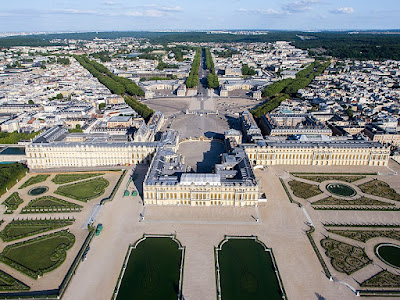
Aerial view of the Palace of Versailles

A film about three kings of France, one of whom was executed …

In 1643, a new king was crowned in France. Officially, he would be known as Louis the Fourteenth, but he is also known by the nickname of “Le Roi Soleil” (or “The Sun King”). Some consider him the longest-reigning absolute monarch in history. The term “absolute” is appropriate here, because he ruled with an iron fist. But this film doesn’t just cover him – they also cover two other kings as well, both of whom were his descendants. One was Louis the Fifteenth, who is known by the nickname “Louis le Bien-Aimé” (“Louis the Beloved”). This nickname is somewhat ironic, because he became somewhat unpopular later on. And the other king was Louis the Sixteenth, who is best known for dying by the guillotine, when he was executed during the French Revolution. They were three kings in a row, with no other kings in between – either by the name “Louis,” or by any other name. Together, they reigned for a period of nearly a century and a half.


Execution of King Louis the Sixteenth by the guillotine, 1793

Wednesday, August 24, 2022

A review of “The Germanic Tribes”


Warning: This blog post contains a picture of an actual human skull from centuries ago.

What is this film about, and why should I care about it?

In the fifth century AD, three Germanic tribes invaded the British Isles. They were called the Angles, the Saxons, and the Jutes. Two of them are sometimes lumped together into the term “Anglo-Saxons,” a major group for British history. It is from the word “Angles” that the word “England” itself comes – and, by extension, “English,” the name for the language in which I’m writing this. But this documentary doesn’t just cover the Early Middle Ages – it also covers the earlier “classical antiquity” period, focusing especially on the time of the Roman Empire. The first three episodes focus on the antagonistic relationship between the Romans and the Germanic tribes. Later on, they talk about the fall of the Western Roman Empire, and Europe’s resulting transition into its “Dark Ages” period. Thus, they talk about the bridge between the classical period and the medieval period in this film.


Latest reconstruction of the Sutton Hoo helmet, a famous Anglo-Saxon helmet

Thursday, July 14, 2022

A review of Cecil Jenkins’ “A Brief History of France” (book)


“The French people solemnly proclaim their attachment to the Rights of Man and the principles of national sovereignty as defined by the Declaration of 1789, confirmed and complemented by the Preamble to the Constitution of 1946, and to the rights and duties as defined in the Charter for the Environment of 2004 [then a future year] … By virtue of these principles and that of the self-determination of peoples, the Republic offers to the overseas territories which have expressed the will to adhere to them new institutions founded on the common ideal of liberty, equality and fraternity and conceived for the purpose of their democratic development.”


This book is skewed towards modern history (but is still good)

I’ve been trying to learn the French language since 2002. When I started learning the language, I was still in my sophomore year of high school. Thus, I’ve been interested in France for at least that long. My interest in the French language had something to do with Canada as well, but it’s hard to understand French Canada (or any other Francophone country) without some understanding of where the language has come from. This is part of what motivated me to get a copy of this book – I wanted to understand the culture of the French language. In this, I was not disappointed, and learned much about the history and culture of France – including the political history. (Although there is much art history in this book as well, for people who are interested in this.)

Wednesday, November 17, 2021

A review of “Modern Marvels: The Suez Canal” (History Channel)


Long before the Panama Canal was built, the Suez Canal was opened in 1869. This is the same year that America’s Transcontinental Railroad had been completed. But the Suez Canal was even more important for world history. It allowed ships to pass from the Mediterranean Sea to the Red Sea, without having to go around Africa. For a trip from Britain to India, a ship could thus save 5,000 miles (8,000 kilometers) by going on this route. This may make the Suez Canal the most important canal in the world – arguably even more important than the Panama Canal, which is saying something.


Opening of the Suez Canal, 1869

Sunday, September 6, 2020

A review of “Lafayette: The Lost Hero” (PBS)


“If War should break out between France and Great Britain, during the continuance of the present War between the United States and England, his [French] Majesty and the said united States, shall make it a common cause, and aid each other mutually with their good Offices, their Counsels, and their forces, according to the exigence of Conjunctures as becomes good & faithful Allies.”

“In order to fix more precisely the sense and application of the preceding article, the Contracting Parties declare, that in case of rupture between France and England, the reciprocal Guarantee declared in the said article shall have its full force and effect the moment such War shall break out … ”

Articles 1 and 12 of the “Treaty of Alliance Between The United States and France” (6 February 1778)

Fellow Americans tend to remember the American Revolution as a time of heroes. The names of FranklinWashington, Adams, HamiltonJefferson, and Madison are known widely in this country. And for many Americans, the Marquis de Lafayette is right up there in the pantheon with these Founding Fathers, even though he was obviously not an American himself. As you may know, he was born a Frenchman, and was a citizen of France throughout his life. He never sought to obtain American citizenship, and was highly patriotic to France. Why, then, is he remembered with such fondness by so many Americans today?


Marquis de Lafayette

Monday, March 23, 2020

A review of “The Plague” (History Channel)


The greatest outbreak of disease in recorded human history (the Black Death) …

It is still the greatest outbreak of disease in recorded human history. Some estimate that the plague killed 30 percent of the European population, but many others place it around 50 percent. To many Europeans of this time, the apocalyptic Plague seemed like “the end of the world,” and there may have been reason for them to see it this way. No war has ever killed as many people as the “Great Plague” did, and the death toll was easily numbered in the millions. Small wonder, then, that this massive outbreak of the fourteenth century is sometimes known simply as “the Plague,” as it is called in this documentary's title.

Saturday, August 24, 2019

A review of “The Dark Ages” (History Channel)


The term “Dark Ages” usually refers to the Early Middle Ages, if it is used at all …

People once used the term “Dark Ages” to refer to the entire Middle Ages. But now, when the term is used at all, it usually refers to just the Early Middle Ages – that is to say, the centuries immediately after the fall of the Roman Empire in the West. A number of people today have actually objected to the use of the term “Dark Ages” itself. But although the History Channel acknowledges the prevalence of this objection, it obviously does not agree with it, as it seems to make clear in this documentary. Whatever you call this period, though, it is clear that the fall of what Westerners today call the “Roman Empire” left chaos in its immediate wake.


Wednesday, November 11, 2015

A review of “The Great War” (1964 BBC series)


"In Flanders fields the poppies blow
Between the crosses, row on row,
That mark our place; and in the sky
The larks, still bravely singing, fly
Scarce heard amid the guns below.

We are the Dead. Short days ago
We lived, felt dawn, saw sunset glow,
Loved and were loved, and now we lie
In Flanders fields."

- "In Flanders Fields" (1915), by Canadian veteran John McCrae

The first series about World War One to interview the veterans

The fiftieth anniversary of the "Great War" - a.k.a. "World War One" - saw two great television documentaries being made to commemorate it. One was made by the Americans, and the other was made by three British Commonwealth nations (BritainCanada, and Australia), working together to make this series. In virtually every way, the one made by the British Commonwealth nations is better, although there are a few areas where the American-made series distinguishes itself. Thus, I will intersperse some commentary on this as well, in a post primarily focused on the British-made series.


"The Great War" DVD (made by British Commonwealth countries)


"World War One" DVD (made by American CBS)

Monday, November 2, 2015

A review of PBS's “Marie Antoinette” movie


"Qu'ils mangent de la brioche." ("Let them eat cakes.")

- The infamous Marie Antoinette line that Marie Antoinette may never have actually said


Other media about Marie Antoinette

Ever since her execution during the French Revolution, Queen Marie Antoinette of France has excited the public imagination. There have been numerous movies about her - including a Hollywood movie from 2006 starring Kirsten Dunst, which I have not seen. These numerous movies may be a measure of how much interest she continues to excite. Generations since then have tried to understand her, and have found that she - like the French Revolution against her - is more complicated than she (at first) appears. It's hard to come up with a simple explanation for why she acted the way she did (and why the public reaction to her was so violent - even bloodthirsty), and I don't pretend to have all the answers here. The documentary that I'm about to review doesn't have all the answers, either; but it does provide a good starting point for understanding Marie Antoinette. It may also be able to provide some useful information about whether the PBS biography movie is a good film for you. It's not for everyone, I should make clear; but for those with an interest in history - and, perhaps, with a strong stomach to go with it - this is a tale that you can learn something from, which tells you a lot about the complicated history of this time.


Francis I - Holy Roman Emperor, King of Germany, and father of Marie Antoinette

Tuesday, July 14, 2015

A review of “The French Revolution” (History Channel)


"There is therefore a purely civil profession of faith of which the Sovereign should fix the articles, not exactly as religious dogmas, but as social sentiments without which a man cannot be a good citizen or a faithful subject.[footnote] While it can compel no one to believe them, it can banish from the State whoever does not believe them - it can banish him, not for impiety, but as an anti-social being, incapable of truly loving the laws and justice, and of sacrificing, at need, his life to his duty. If any one, after publicly recognising these dogmas, behaves as if he does not believe them, let him be punished by death: he has committed the worst of all crimes, that of lying before the law."

- Jean-Jacques Rousseau, "The Social Contract" (1762), Book IV, Chapter VIII

It was begun with the best of intentions, but it ended with the worst of results ...

It is a revolution that is both celebrated and despised, sometimes even by the same people. It was begun with the best of intentions and the noblest of ideals, but it ended with the worst of results after thousands of deaths by mob violence and the guillotine. And it started out as a rebellion against one monarch, and replaced it with the de facto dictatorship of another - Napoleon Bonaparte.


Napoleon Bonaparte during this time

The History Channel gives it a fine treatment here ...

In the English-speaking world, the best documentary that I know of about this subject is the History Channel's presentation simply entitled "The French Revolution." It has the usual problem for a History Channel program - namely, a touch of sensationalism, and excessively dramatic music at times. (The attempt to add drama through intense music is often overdone, with one feeling like they could have actually achieved greater impact through understatement.) Nonetheless, this film is a fine treatment of the events in France. It belongs on the shelf of anyone interested in the French Revolution despite its weaknesses. Thus, I thought that I would offer a review of this film here.


Marquis de Lafayette

Monday, November 17, 2014

A review of Kenneth Clark's “Civilisation”


"Great nations write their autobiographies in three manuscripts: the book of their deeds, the book of their words, and the book of their art. Not one of these books can be understood unless we read the two others. But of the three, the only trustworthy one is the last."

John Ruskin, a 19th-century art critic

Disclaimer: I know virtually nothing about the visual arts ...

So I recently finished watching Kenneth Clark's "Civilisation" (spelled the British way), a documentary series about the history of Western art. Before I begin my review of it, I should give a disclaimer that I know virtually nothing about visual art. I have never taken an art class, nor a photography class, nor an art history class. I play a little piano and do a little writing, so I have some experience with non-visual arts after a fashion; but I know next to nothing about the more visual arts. I don't even particularly like looking at most art, lacking an appreciation for it. In my adulthood, I found out the reason why: I have, quite simply, very little visual intelligence. When taking tests of my intelligence, I scored in the medium range for math and in somewhat higher ranges for language - scores which corresponded to my later scores on the GRE's. But I tested in the bottom 1 percent of the population for visual-spatial intelligence. This would explain why I've never been that interested in scenery, or why I didn't like my geometry class in high school - I am just not a visual person.


... but I am a history buff, which is what attracted me to this series

I am, however, a history buff; which is what attracted me to this series. I thought I'd shore up this intellectual weakness of mine by learning about art history, which is an excellent prism for talking about the history of mankind generally. Kenneth Clark opens this series with an interesting quote from John Ruskin, the 19th-century art critic, who said: "Great nations write their autobiographies in three manuscripts: the book of their deeds, the book of their words, and the book of their art. Not one of these books can be understood unless we read the two others. But of the three, the only trustworthy one is the last." This may be overstating the case a little bit - I often find words a trustworthy way of understanding people, and deeds even moreso. (In the admittedly cliché words of an old saying: "Actions speak louder than words.") But nonetheless, you can find out a lot about a people by studying their art. It tells you a lot about their values, their ideas, and their culture; and art history is thus an excellent way to gain insight into a people.


Leonardo da Vinci's "Mona Lisa," from the sixteenth century

Friday, August 15, 2014

A review of PBS Empires “Napoleon”


"Glory is fleeting, but obscurity is forever."

- Napoleon Bonaparte

He was the ruler of France, but learned French as a second language, and spoke it with an accent. He praised the egalitarian ideals of the French Revolution, but always considered himself a little more equal than everyone else (much like a Marxist that way). And he was a military genius whose victories brought him glory and power, but who lost it all through the tragic flaw of always wanting more, and never knowing where to stop.


How Napoleon is perceived in America

The man was Napoleon Bonaparte, and his name is well known to young and old. But few in America know much about him, or care. It's not only that he lived far away from the world we live in - Americans have a never-ending interest in (and horror of) Adolf Hitler, even though he too was across the Atlantic. But Napoleon is perceived to have had little or no effect on American history. Part of it may be that he was so long ago, but part of it may also be the perception that he was beneficial to our country - that his fighting our mutual enemy of that time (Great Britain) kept us from losing our War of 1812. There may be some truth in this; but regardless of one's feelings about it, he was a major foreign policy issue for the presidencies of John Adams, Thomas Jefferson, and James Madison; and was the central fact of domestic life for the vast majority of the continent of Europe. He hit very close to home for them, and inspired a never-ending fascination with his life that lives on in Europe today.


Friday, June 6, 2014

A review of “The World at War” (World War Two series)


"This morning the British Ambassador in Berlin Nevile Henderson handed the German Government a final note stating that unless we heard from them by 11 o'clock, that they were prepared at once to withdraw their troops from Poland, that a state of war would exist between us. I have to tell you now that no such undertaking has been received, and that consequently this country [Great Britain] is at war with Germany."

- British prime minister Neville Chamberlain, in a speech given from the Cabinet room at 10, Downing Street on 3 September 1939

World War II is a subject that continues to fascinate millions throughout the world. From people in the losing countries to people in the winning ones, everyone seems to be fascinated by World War II. Because of this, there continue to be media of all kinds about the subject, and a viewer interested in it has many options to choose from. Indeed, there almost seems to be a choice overload (a nice problem to have), and it's hard to know which ones are the best.


D-Day invasion at Omaha Beach - Normandy, 1944

This documentary depicts stories from all over the world, on both sides of the conflict

"Best" is a subjective term, and what is best in the eyes of one may not be best for another. But if asked my opinion on which documentary is the best, my vote would go to "The World at War," the classic British documentary from the 1970s. From the British and Americans to their reluctant Soviet allies, to the Axis powers of Germany and Japan, stories from all over the world are told, and woven together into a fascinating narrative about the events of World War II.