Showing posts with label Native American history. Show all posts

Friday, November 26, 2021

A review of PBS’s “Native America”


“An act to provide for an exchange of lands with the Indians residing in any of the states or territories, and for their removal west of the river Mississippi … ”

– Full title of the “Indian Removal Act of 1830,” as passed by the United States Congress

This television history of Native Americans is more cultural anthropology than history

This television history of Native Americans seems to be more cultural anthropology than history. In part, this is because they are focused primarily on pre-Columbian history (or history before Columbus). This may explain why they don’t rely much on written records, whose availability for this period is somewhat limited – although I should acknowledge that some examples of it do exist here. History is defined more as the study of written records from the past, whereas archeology is more about the study of physical objects from the past. There is some overlap between these things, but there are also some significant differences. By this traditional distinction, there isn’t much history in this documentary, although there is much archeology in it. More to the point, there is also a lot of cultural anthropology in it. This seems to be one of the weaknesses of this documentary. I tend to be a little skeptical of cultural anthropology in general. (Although I tend to be more supportive of physical anthropology, which I see as quite different.) Cultural anthropology has some interesting things to say, but it would seem to be more humanities than social science, and makes a lot of assumptions that are hard to support scientifically. These assumptions underlie much of the discussion in this documentary.

Thursday, April 30, 2020

A review of Ken Burns’ “The Vietnam War” (PBS)


“ ♪ How many roads must a man walk down,
Before they can call him a man?
How many seas must a white dove sail,
Before she sleeps in the sand? ♪

“ ♪ Yes, and how many times must the cannon balls fly,
Before they're forever banned?
The answer, my friend, is blowin' in the wind –
The answer is blowin' in the wind. ♪ ”

Bob Dylan's “Blowin' in the Wind” (released 1963), an anti-war song not used in this film

Our national debate about the Vietnam War began during the war itself …

Our national debate about the Vietnam War began during the war itself, and continues today in full force. The Ken Burns series is just a relatively recent contributor to this national debate, albeit a very important one. Contrary to popular opinion – and, to some extent, that of this series itself – America actually won most of the battles in that conflict. Nonetheless, it is quite true that we lost the war when we withdrew in 1973, and thus allowed South Vietnam to fall to communism. The doves and the hawks do not really agree on much about this war, but one thing is universally agreed upon: the war was a disaster for the United States and its allies. It caused their prestige to dwindle somewhat abroad, and gave them a reputation for lacking the political will to fight, let alone to stand up to the attempted expansion of communist regimes. (And unlike many other writers, I will not pretend that I have no opinion on this subject; but will admit my partiality up front, honestly and unabashedly.)


Thursday, November 21, 2019

A review of Ric Burns’ “The Pilgrims” (PBS)


“Having undertaken for the Glory of God, and Advancement of the Christian Faith, and the Honour of our King and Country, a Voyage to plant the first Colony in the northern Parts of Virginia; [we] Do by these Presents, solemnly and mutually, in the Presence of God and one another, covenant and combine ourselves together into a civil Body Politick, for our better Ordering and Preservation, and Furtherance of the Ends aforesaid … ”

The Mayflower Compact, 11 November 1620 by the old calendar (or 21 November 1620 by the new calendar)

I grew up with the story of the Pilgrim Fathers, who settled at Plymouth Rock in Massachusetts (and not in Virginia, as they had originally intended). It is one of the great stories in American history, but it was not the beginning of the English colonies on this continent. Before the Mayflower landed at Plymouth Rock in 1620, there was a settlement in Jamestown, Virginia in 1607. But this Jamestown settlement wasn't anywhere near as successful as the later Pilgrim settlement. Both were racked by starvation and disease that claimed many lives, but the Pilgrim settlement survived, when the Jamestown settlement did not. Some brief comments about the Jamestown settlement may thus be warranted here, to give you an appreciation of what the Pilgrims did (although their success was marred somewhat by their relations with the Indians, in the ways that I will note soon).


Some brief comments about the Jamestown settlement (and the PBS documentary about it)

Regarding the Jamestown settlement, I actually purchased another documentary called “Secrets of the Dead: Jamestown's Dark Winter” (also by PBS). This voyage did actually land in Virginia, as they had originally intended (unlike the Pilgrim voyage, which landed in Massachusetts). But sadly for me, this Jamestown documentary was more focused on the archaeology involved than on the history. Thus, it is not to be construed as an actual “history” of the Jamestown settlement. The focus here is on the archaeological examination of the human remains found there. For example, they were able to show in this documentary that the grim stories about resorting to cannibalism at Jamestown were actually true. Although this was gross, it was certainly dramatic enough; but it did not satisfy my craving for the human story of what happened there. There was some passing mention of John Smith and Pocahontas, for example, but most of the story centered on the body of a teenage girl whose real name is unknown (although they call her “Jane” to identify her as a Jane Doe.) The definitive documentary about what happened at Jamestown, it would seem, thus has yet to be made at the time that I write this. By contrast, this documentary about “The Pilgrims” was much better; although it was not without some revisionist elements that I will note later on in this post. For now, I will just say that I found it to be entertaining despite its revisionism, and would recommend it to others anyway.


Tuesday, July 2, 2019

Some parts of the Constitution mention “Indians” or “Indian tribes” …


“[The Congress shall have the power] To regulate commerce with foreign nations, and among the several states, and with the Indian tribes … ”

Article 1, Section 8, Paragraph 3 of the United States Constitution

When people today talk about the original Constitution, they often mention specific clauses that are relevant to black history. These include the Slave Importation Clause, the Fugitive Slave Clause, and the Three-Fifths Clause. When people today talk about the civil rights amendments, they often mention the abolition of slavery by the Thirteenth Amendment (and rightfully so). But when they talk about minority history, they seldom discuss the clauses specific to Native American history, even though the words “Indians” and “Indian tribes” are mentioned in three different clauses from either the original Constitution or its amendments.


Constitution of the United States

It is important to be clear on this point: there are actually no clauses in the Constitution that mention Hispanic AmericansAsian Americans, or Pacific Islander Americans by any of their specific names. There are clauses specifically about African Americans, but none that mention them by name (even by names like “blacks”). However, three clauses from either the original Constitution or its amendments mention “Indians” or “Indian tribes” by these names. Thus, I would like to go over all of these clauses here, and show what the “supreme law of the land” has said about the legal status of Native Americans.


Charles Curtis (the 31st Vice President of the United States),
who was of Kaw, Osage, Potawatomi, French and British ancestry – served 1929–1933

Friday, April 19, 2019

A review of “Rebels & Redcoats: How Britain Lost America”


“... That the said colonies and plantations in America have been, are, and of right ought to be, subordinate unto, and dependent upon the imperial crown and parliament of Great Britain; and that the King's majesty, by and with the advice and consent of the lords spiritual and temporal, and commons of Great Britain, in parliament assembled, had, hath, and of right ought to have, full power and authority to make laws and statutes of sufficient force and validity to bind the colonies and people of America, subjects of the crown of Great Britain, in all cases whatsoever … ”

American Colonies Act 1766 (better known as the “Declaratory Act”), as passed by the Parliament of Great Britain

A British view of the American Revolution, which is somewhat different from our own ...

This documentary has much to admire, and much to disagree with. Its opening credits advertise it as “A British View,” and this title is certainly accurate. I picked it up hoping to hear the other side of this war, and I was not disappointed. However, it also has some weaknesses which I will note here. To be fair, it is actually fairly balanced regarding the military campaigns, but it is also somewhat less than balanced regarding some of the politics of this war. The British filmmaker Richard Holmes is a genuine military historian, and has a deep knowledge of military strategy and tactics. He has a gift for bringing the human drama of these campaigns to life. He has the ability to make you sympathize with both sides to some degree. But when it comes to the political issues of this war (and there are quite a few of them), he shows that he is not very well-versed in the politics of the Revolution. He compares people like Samuel Adams to Marx and Lenin, and it is clear that this comparison is meant to be unflattering (and not a comparison that is meant to be complimentary, as it might be if spoken by someone else).


Sunday, November 11, 2018

A review of PBS's “The Great War” (American Experience)


“We [the German government] intend to begin on the first of February unrestricted submarine warfare. We shall endeavor in spite of this to keep the United States of America neutral. In the event of this not succeeding, we make Mexico a proposal of alliance on the following basis: make war together, make peace together, generous financial support and an understanding on our part that Mexico is to reconquer the lost territory in Texas, New Mexico, and Arizona.”

Zimmermann Telegram (1917), one of the events that led to the American entry into World War One

President Woodrow Wilson walked a tightrope during the early years of World War One, trying to steer a middle course between full neutrality and full involvement. Of course, Americans did not declare war on Germany until April 1917, and waited even longer than that to send troops to Europe. But even at the beginning of the war in 1914, most Americans did not want the Germans to win, and some of them actually sold food (and sometimes weapons) to the Allied nations. There was a massive peace movement before America officially got involved, and PBS makes sure to cover it here. But there were also many supporters of getting involved sooner - and this, too, receives some good coverage from PBS. Among the supporters of earlier American involvement was the former president Theodore Roosevelt. Roosevelt was a major critic of Wilson for his perceived lack of muscle in this struggle - a correct perception. But Wilson was also criticized by the peace movement for supporting aid to Britain and France. Thus, he was having a hard time walking this tightrope within his own party. Unfortunately for Wilson, this balancing act would prove even harder when the Germans sank the RMS Lusitania in 1915.


Sinking of the RMS Lusitania, 7 May 1915

Monday, May 28, 2018

A review of “The War That Made America”


"Since the English have in their power an officer and two cadets, and, in general all the prisoners whom they took when [they] assassinated Sieur de Jumonville they now promise to send them with an escort to Fort Duquesne, situated on Belle River, and to secure the safe performance of this treaty article, as was as of the treaty ... "

- English translation of the "Articles of Capitulation" after the Battle of Fort Necessity, Article 7 - the French text of which was mistakenly signed by George Washington (who did not speak French) on 3 July 1754, in the belief that the translation given to him had been accurate (which it probably wasn't)

This documentary is about the French and Indian War, not the American Revolutionary War ...

When most people hear the phrase "the war that made America," the event they would think of is the "American War of Independence." (Or as we call it in America, the "American Revolution," or the "American Revolutionary War.") Most people would be surprised to learn, then, that this is about the "French and Indian War" - or the "Seven Years' War," as it's known elsewhere (including in Canada). This war took place over a decade before the creation of the United States, and ended some years before the first shots of the Revolution were fired at Lexington and Concord. It's also important for the future history of Canada, because it turned Canada from a French colony into a British colony, and thus secured the dominance of English speakers in the region. The year 1759 is thus a controversial year in Canadian history, and it is resented bitterly by French Canadians - not to mention the First Nations Canadians. Nonetheless, it is American history that is the focus here, even if the documentary is narrated by the First Nations Canadian Graham Greene (which it is).


Battle of the Plains of Abraham - Quebec, 1759

The bitter strife of the Revolution actually had its roots in this war

At this time, the British Crown ruled the Eastern Seaboard of this continent, and its colonies were loyal outposts of the British Empire. These colonies all had their own militias that took part in this struggle, but they were not terribly impressive compared to the professional Redcoat soldiers, who arrived from Britain in considerable numbers after the war began. These Redcoat soldiers were the real backbone of the British presence there, and they had reason to view the colonial militias with some contempt. They were tactless enough to express this contempt more than once, and there were signs of friction between the two even during this period. The colonial governments resisted London's attempts to pay for the war by taxing the colonies, and they actually insisted on retaining local control over the colonial militias with regards to staffing and - even more importantly - military strategy. The bitter strife of the Revolution thus had its roots in this war; and the two groups' fighting alongside each other was a temporary situation that would not last.


The Albany Congress - New York, 1754 (one of the precursors to the later Continental Congresses)

Tuesday, January 23, 2018

Who can vote in the United States?: The voting rights amendments


" ... that government of the people, by the people, for the people, shall not perish from the earth."

- Closing lines of Abraham Lincoln's "Gettysburg Address" (November 19, 1863)

Many Americans have historically been denied the vote in this country ...

Voting rights are one of the most important rights that anyone can have in a free country. They are a right by which many others can be defended, and the essence of popular government in democracies and republics. But voting rights were long restricted in this country to white male citizens who had private property, and who were 21 years of age or older. They could be denied for failure to pay poll taxes, for having ancestors that had been enslaved, or for any number of other things that were used as restrictions on the right to vote.


Frederick Douglass, a notable advocate of African American voting rights

... and the changes in these policies were made somewhat gradually over a period of decades

It took a long time for this situation to be rectified, and the changes brought herein were made somewhat gradually over a period of some decades. Thus, it would seem appropriate to review them now, and show what categories are forbidden to be used as legal grounds for denying people the right to vote. (I should acknowledge that some would classify the Twenty-Third Amendment as a voting rights amendment as well; but since this amendment is more relevant to the electoral college than it is to individual suffrage, I have saved that discussion for another post. I will focus this post instead on the four amendments about voting rights at the individual level.)


Martin Luther King, another notable advocate of African American voting rights

Friday, December 1, 2017

The First Amendment: Protecting religion from government (and not the other way around)


"Believing with you that religion is a matter which lies solely between man and his God, that he owes account to none other for his faith or his worship, that the legislative powers of government reach actions only, and not opinions, I contemplate with sovereign reverence that act of the whole American people which declared that their legislature should 'make no law respecting an establishment of religion, or prohibiting the free exercise thereof,' thus building a wall of separation between Church and State."

- Thomas Jefferson to the Danbury Baptist Association, on January 1, 1802

The most hotly debated sentence in American history

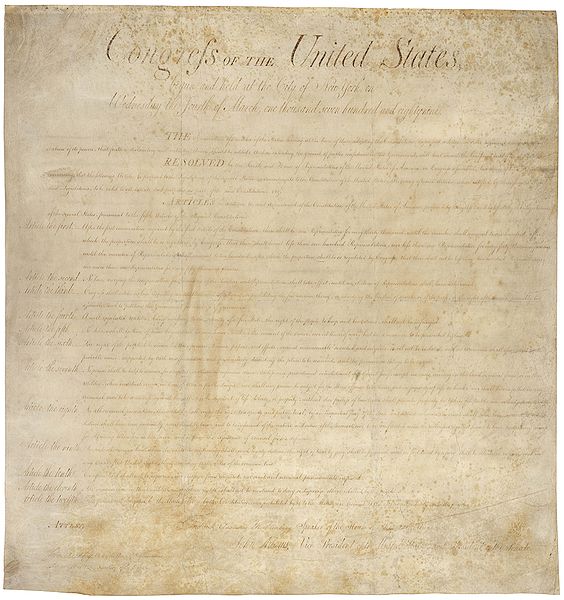
The Constitution has many passages in it that are hotly debated today, and these debates will likely continue for years to come. But if I were asked what is the most hotly debated sentence in American history, my vote might well go to this one: "Congress shall make no law respecting an establishment of religion, or prohibiting the free exercise thereof; or abridging the freedom of speech, or of the press; or the right of the people peaceably to assemble, and to petition the government for a redress of grievances." (Source: First Amendment) This is the Constitution's famous First Amendment, and it is indeed the first of the ten amendments that make up our modern "Bill of Rights." It would also seem to be the first thing that the people of that time wanted to include when they endeavored to list various "rights" in the Constitution via the Bill of Rights, and so one might surmise that these rights need to be understood today by the people who live here.


Thomas Jefferson

Establishment of religion, or "prohibiting the free exercise thereof"

The very first thing that this amendment mentions, I should acknowledge here, is respecting an "establishment of religion." This clause has been sometimes associated with a famous phrase by the American Founding Father Thomas Jefferson, which is "a wall of separation between Church and State." This is a phrase that rings loudly in the ears of atheists today, because of the persecution that they see from the Christian majority surrounding them. Indeed, atheists love to remind society that so many Founding Fathers were actually Deists (rather than Christians), and that they were thus somewhat different from the "Christian majority" surrounding them (which they delight in pointing out often). But between the "establishment of religion" clause and the amendment's first semicolon is one other important phrase - and only one other phrase - which is the part forbidding government from "prohibiting the free exercise" of their religion. This clause has long been associated with the phrase "freedom of religion," which is a phrase that rings loudly in the ears of unabashedly-religious people in the same way; and which is similarly revered as sacred.


United States Bill of Rights

Tuesday, January 24, 2017

A review of PBS's “The Gold Rush”


The California Gold Rush is one of those events that tends to have been heard of by the public, but is often overlooked by popular historians today for a number of reasons,. Among them is that it is partially an economic story, and thus considered less "sexy" than the more "traditional" topics of politics and the military. Nonetheless, the Gold Rush is a monumental event in the history of America which had massive repercussions on the history of the West, causing the rapid colonization of California by White immigrants (and a handful of Chinese immigrants), and creating the ethnic mix that California is so known for today - since it is a race relations story as much as it is anything else, fraught with interest for anyone interested in American history. (But more on the particulars of that later.)


Sutter's Fort - California, 1849 (not to be confused with Sutter's Mill)

Sunday, June 26, 2016

A review of Ken Burns’ “The West”


"Nevada Territory is fabulously rich in gold, silver, lead, coal, iron, quicksilver... thieves, murderers, desperadoes ... lawyers, Christians, Indians, [Chinese], Spaniards, gamblers, sharpers, coyotes, poets, preachers and jackass rabbits."

Samuel Clemens, who would later become known as "Mark Twain"

I have had a strong love-hate relationship with Ken Burns' "The West" ever since I first saw it, perhaps having more mixed feelings about it than any other documentary that I've ever seen. There is so much good in it, and there is so much bad in it. I sometimes remember parts of it fondly when coming into contact with the history that it covers, but I also remember an overall negative impression that I received from much of the series. This is one of those series where political correctness is taken to levels that are a bit on the extreme side, which is strong enough to detract from the quality of some parts of it. Some parts of it are also quite good, which makes it hard for me to reject it outright; but my overall impression of this series has been generally negative since first watching it. It has much of value in it, but my memory of this series has tended to be negative.


Hernán Cortés

Monday, May 2, 2016

Latin America became independent because of Napoleonic Wars – (well, partially)


" ... the American continents, by the free and independent condition which they have assumed and maintain, are henceforth not to be considered as subjects for future colonization by any European powers ... "

- The Monroe Doctrine, expressed by James Monroe (then the President of the United States) in his Seventh Annual State of the Union Address (2 December 1823)

What does Napoleon have to do with Latin American independence?

When Napoleon's troops went to occupy Spain and Portugal, they set off a chain reaction of events that had massive effects on the Spanish and Portuguese colonies in Latin America - including, eventually, independence. But I'm getting ahead of myself.


Napoleon Bonaparte

Friday, January 8, 2016

A review of “The War of 1812” (PBS program)


"No refuge could save the hireling and slave
From the terror of flight or the gloom of the grave,
And the star-spangled banner in triumph doth wave
O’er the land of the free and the home of the brave."

- Excerpt from a lesser-known verse of "The Star-Spangled Banner," written by Francis Scott Key in 1814

This war would be unthinkable today ...

It's hard to imagine today that there could have been a war between America, Britain, and Canada - and in those rare times when we do imagine such a war, the war that Americans usually think of is the American War of Independence (or the "American Revolution," as we in America usually call it). Most Americans have some vague recollection from their middle school history class that there was a war in 1812, but they couldn't give you much information at all about where it was fought, or whom it was fought against. Even the "when" of the war is somewhat unknown, since the term "War of 1812" is actually something of a misnomer. "The War That Began in 1812" would be a more accurate term, since the war actually lasted until the year 1815. This is not communicated by the phrase "War of 1812," which makes it sound like it lasted only a single year (when in fact, it lasted for nearly three).


The death of British General Sir Isaac Brock at the Battle of Queenston Heights - Canada, 1812

Wednesday, September 16, 2015

A review of “Mexico: A History” (by Robert Ryal Miller)


"[The Mexican Empire] solemnly declares by means of the Supreme Junta of the Empire that it is a Sovereign nation and independent of old Spain ... "

Declaration of the independence of the Mexican Empire, issued by its Sovereign Junta, assembled in the Capital on September 28, 1821

Since early 2012, I have made an effort to learn the Spanish language. The reasons for this are many (and too long to detail here), but chief among them is the local usefulness of the language. I live in Arizona (in the American Southwest); so Spanish is the most important local language besides my native English. The opportunities to use Spanish here are endless, and I have long wanted to know something about the Hispanic population of the Southwest. I have interacted with them for years, at school and at church.


Mexican flag

Mexico has a strong influence on the American Southwest

In the American Southwest, most of the Hispanics are of Mexican descent - in contrast to the strong Cuban descent found in Florida, and the strong Puerto Rican descent found in New York - the other parts of the United States where Spanish-speaking populations are most often found. In the American Southwest, people of Mexican origin are the most common ones, and so I thought it might be helpful to know something about their country of origin. Mexico is one of my country's only two neighbors, incidentally (the other being Canada). It is also the one that is closest to my home state of Arizona - and thus, the nation that we Arizonans do the most trade with outside of our own. (Stuff that my American audience already knows, I'm sure; but I have an international audience here, so the geography of my situation is worth going over.)


Thursday, August 13, 2015

A review of Michael Wood's “Conquistadors”


A disturbing and intensely fascinating human drama ...

It caused the fall of empires, and the rise of a new one in their place. It changed the destiny of continents, and left the imprint of Europe on their face. And it was a tale of cruelty and ruthlessness - a disturbing and intensely fascinating human drama - which forever changed the Western Hemisphere; and by extension, the entire world.


Machu Picchu, Peru

The story has an air of Shakespearean tragedy to it ...

The event is, of course, the Spanish Conquest; and generations of schoolchildren have grown up with the story of how it happened. The story has an air of Shakespearean tragedy to it, of complicated characters who manage to be sympathetic even when callous and cruel; and even the brutality and horrors of it cannot stop it from being interesting, captivating, and utterly compelling. We may not like it, but we'll never be able to get away from it; and instead of ignoring it, there is value in learning about this epic tale; and hearing of the tremendous impact it has left on our civilization, and our world.


Moctezuma II being held captive by Cortés, circa 1519 or 1520

Saturday, July 4, 2015

A review of “Liberty! The American Revolution” and “The Revolution”


"The history of the present King of Great Britain is a history of repeated injuries and usurpations, all having in direct object the establishment of an absolute tyranny over these states."

"In every stage of these oppressions we have petitioned for redress in the most humble terms; our repeated petitions have been answered only by repeated injury. A prince, whose character is thus marked by every act which may define a tyrant, is unfit to be the ruler of a free people."

- The Declaration of Independence (July 4, 1776)

It was the most successful revolution in history (and the most underrated), but one in which the winning side lost almost every battle that it fought. It was a war with dramatic battles and military campaigns, but whose greatest revolution was in political thinking and good government. And it was a war with larger-than-life heroes who were immortalized in statues and monuments; but it was won by the tireless efforts of ordinary people, without whose efforts the war would surely have been lost.


John Trumbull's Declaration of Independence

The war was a desperate one, and the Americans came pretty close to losing it ...

The American Revolution it created became the most powerful nation in the world, but was one of the weakest nations for most of its early history. Indeed, it would never have won its independence at all without the help of foreign powers (especially France), and the war was a desperate one whose outcome was not the inevitable victory that it is often painted to be. The Americans could very well have lost that war, and the country as we know it would never have existed: the world would have been a very different place.


Sunday, May 10, 2015

A review of PBS's “Transcontinental Railroad” movie


"[The Congress shall have the power] To establish post-offices and post-roads ..."

- The United States Constitution, Article 1, Section 8, Paragraph 7

It allowed a continent to be crossed in just a week, where before it had taken six months or more. It enabled fast transport for trade goods of all kinds, connecting the economies of the continent's East and West coasts. And it unleashed a wave of settlement and colonization, which would have massive effects on the population spread and distribution in the West - and by extension, the history, politics, economics, and even geography of the country.


Snow gallery (a portion of the railroad), while under construction

Thursday, April 9, 2015

A review of Ken Burns’ “The Civil War” (PBS series)


"Fondly do we hope, fervently do we pray, that this mighty scourge of war may speedily pass away. Yet, if God wills that it continue until all the wealth piled by the bondsman's two hundred and fifty years of unrequited toil shall be sunk, and until every drop of blood drawn with the lash shall be paid by another drawn with the sword, as was said three thousand years ago, so still must it be said that 'the judgments of the Lord are true and righteous altogether.' "

- Abraham Lincoln's Second Inaugural Address (March 4, 1865)

It was the bloodiest war in American history, with more American dead than World War II. It was a war that both sides thought would last ninety days, but which ended up dragging on for nearly four years. And it was a war that freed four million Americans from bondage, and brought some sweeping changes to American society.


Confederate dead at Antietam

Monday, February 2, 2015

A review of “The U.S.-Mexican War 1846-1848” (PBS series)


"The occupation, separation, and annexation [of Texas] were, from the inception of the movement to its final consummation, a conspiracy to acquire territory out of which slave states might be formed for the American Union."

"For myself, I was bitterly opposed to the measure, and to this day regard the war, which resulted, as one of the most unjust ever waged by a stronger against a weaker nation. It was an instance of a republic following the bad example of European monarchies, in not considering justice in their desire to acquire additional territory."

Ulysses S. Grant, in "Personal Memoirs of Ulysses S. Grant," Chapter III

I live in a region of the United States that was once controlled by Mexico (in the state of Arizona), so I live daily with the effects of a war from the 1840's. Few people could put this war in the right half-century, let alone the correct decade; and fewer still could name any major battles or players in this war. Nonetheless, the effects of the war are all around us, and it has entered discussions about contemporary politics on more than one occasion. On topics ranging from illegal immigration to anti-Hispanic racism to foreign policy towards Mexico, we in the American Southwest are often reminded of this war. In less controversial ways, we are reminded of it in the many place names of Spanish origin that surround our homes. From names of streets to names of cities to names of entire states, the influence of Spanish place names are all around us, which were often borrowed in their turn from the native peoples of the region. Mexican culture is all around us, from Spanish taught in schools to the remarkable Mexican food that many of us eat; and the region would belong to Mexico still, if not for a long-ago war from the 1840's.


Mexico lost half its territory to the United States in this war ...

The war was, of course, fought between the United States and Mexico, and was the only major war between our two nations. There have been border skirmishes since then (notably one in the 1910's), but nothing on the massive scale of this one from the 1840's. Mexico lost half its territory to the United States in this war, and several American states were formed out of the land transferred in the peace treaty. The war was undoubtedly an act of imperialist aggression motivated (to some degree, at least) by racism. But there's more to the story than that. Imperialism and racism are favorite topics of liberal PBS; but surprisingly, the network manages to tell the story in a documentary for television with a minimum of political correctness, and manages to stick to the facts about this topic most of the time. My judgments might not completely agree with theirs, but I have to hand it to them that their documentary about this war is extremely interesting, and it is of tremendous value to the student of American history, particularly those who (like me) live in the Southwest. Thus, I thought I would offer my review of this documentary here.

Friday, June 6, 2014

A review of Ken Burns’ “The War” (World War Two series)


"The German Government, consequently, discontinues diplomatic relations with the United States of America and declares that under these circumstances brought about by President Roosevelt Germany too, as from today, considers herself as being in a state of war with the United States of America."

German Declaration of War with the United States (11 December 1941), four days after Pearl Harbor

With a great subject and the superb direction of Ken Burns, you'd think PBS's "The War" would be one of my favorite documentaries. I'm a big fan of several Ken Burns films (especially "The Civil War"), and I have loved many documentaries about World War II (especially "The World at War"). And it is true that I like this documentary; but it isn't one of my favorites. The focus that it chooses is both a strength and a weakness; and for someone like me, it's mainly a weakness.


Limiting the story to Americans has its weaknesses at times ...

What is the focus that I talk about? Mainly, it's the fact that World War II is told through the eyes of four American towns. It's a brilliant depiction of life in these four places; and in a broader sense, life in wartime America generally. Yet it is also the weakness of this documentary - limited in its geographic area, they have fewer interviewees to choose from; and not all of them are equally interesting. More importantly, the documentary focuses entirely on America; and shies away from depicting anything outside of it - whether that be from our allies (mainly the British Commonwealth and the Soviet Union), or from our enemies (mainly Nazi Germany and Imperial Japan). It would be as if he did "The Civil War" from only the point of view of the North. Yes, that point of view is important (and ultimately the right one); but the war is not understood from an exclusive focus on either side. You have to depict both sides to get a true understanding of the war.


Japanese army enters Nanking, 1937